Choosing the right smart door lock is not simply about comparing fingerprints, face recognition or app functions.
For distributors, importers, door manufacturers, smart home brands and project buyers, a smart lock also needs to match the local door type, lock body, installation conditions, customer needs and application.
Before ordering samples or placing a bulk order, here are the key factors to consider.
1. Start With the Door and Lock Body
The first step is to confirm whether the smart door lock is compatible with the target door.
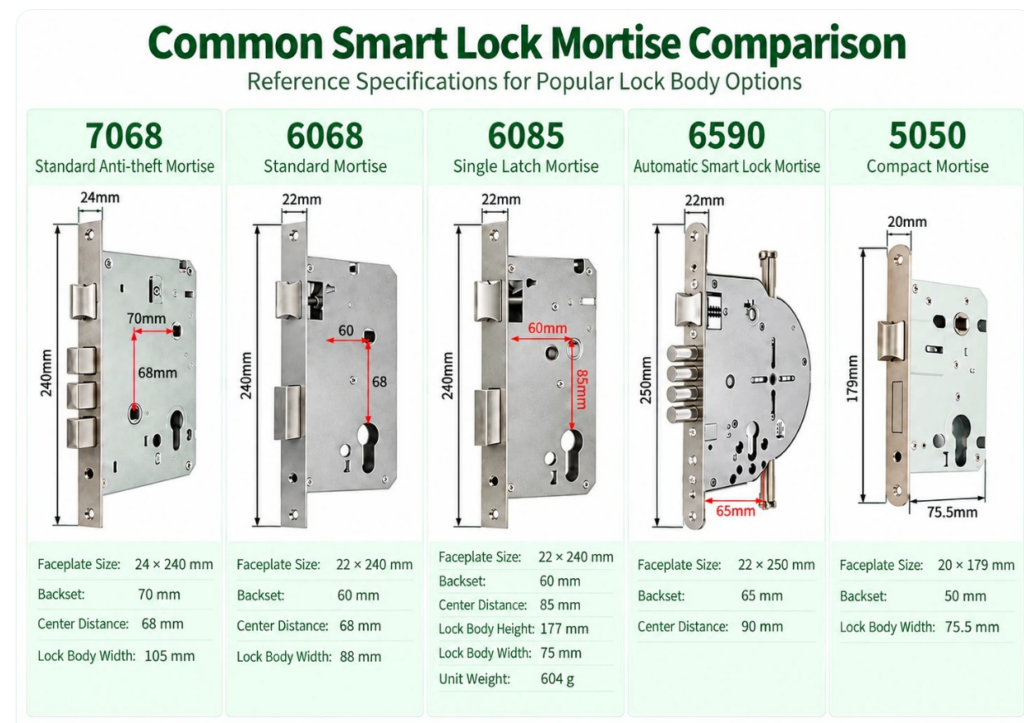
Common lock body specifications include 5050, 6068, 6085, 6590 and 7068. However, the same specification does not always mean universal compatibility.
Actual compatibility depends on the door thickness, lock body dimensions, door structure, opening direction and installation space.
Before confirming a model, buyers should provide:
- Door thickness
- Existing lock body dimensions
- Door photos
- Opening direction
- Lock body photos or drawings
For larger projects, confirming these details early can help reduce installation problems later.
2. Choose Features Based on Your Target Market
Modern smart door locks can support fingerprint recognition, PIN codes, cards, Bluetooth, mobile apps, Wi-Fi, temporary passwords, 3D face recognition and video functions.
More features do not necessarily mean a better product.
For standard residential applications, fingerprint, PIN and mechanical key access may be sufficient.
Premium homes may require 3D face recognition or remote access, while rental properties may place more value on temporary passwords, user management and access records.
For B2B buyers, the goal is to find the right balance between features, cost and market demand.
3. Check Connectivity and App Requirements
Smart locks may use Bluetooth, Wi-Fi, gateways or mobile apps depending on the model and application.
Before purchasing, buyers should confirm:
- App functions
- Remote access
- Temporary password management
- Access records
- Multi-user management
- Gateway requirements
- Smart home integration
The best solution is not necessarily the one with the most connectivity options. It should match the actual needs of your customers and projects.
4. Check Power Supply and Emergency Access
Power supply directly affects the user experience of a smart door lock.
In addition to battery type and expected battery life, buyers should check:
- Low-battery alerts
- Charging or battery replacement
- Emergency power
- Backup unlocking methods
Depending on the model, emergency access may include Type-C external power and a mechanical key.
A reliable backup solution is especially important for international markets where after-sales support may be more complicated.
5. Evaluate Durability and Product Testing
A smart door lock combines mechanical and electronic components, so appearance alone is not enough to evaluate quality.
B2B buyers should ask about testing such as:
- Lock cycle testing
- Handle durability testing
- Fingerprint and keypad testing
- Battery testing
- High- and low-temperature testing
- Salt spray testing
- Water resistance testing
For outdoor or semi-outdoor applications, environmental conditions such as temperature, humidity, dust and corrosion should also be considered.
6. Test Samples Before Bulk Ordering
Sample testing is an important step before placing a large smart lock order.
During testing, buyers should check:
- Door compatibility
- Installation
- Fingerprint or face recognition
- App operation
- Battery performance
- Emergency access
- Accessories
- Packaging
- Overall user experience
If the final model has not yet been selected, comparing products at different price and feature levels can also help identify the right market position.
7. Confirm OEM and ODM Requirements Early
For distributors, importers and private-label brands, OEM and ODM requirements should be confirmed before mass production.
Customization may include:
- Logo
- Product color
- Packaging
- User manual
- Language
- Lock body configuration
- Installation accessories
- Product functions
For larger projects, a detailed product specification sheet can help both the buyer and manufacturer confirm the final configuration.
8. Choose the Right Smart Lock Manufacturer
The supplier is just as important as the product.
When evaluating a smart lock manufacturer, B2B buyers should consider:
- Manufacturing capability
- Product development
- Quality control
- Testing procedures
- OEM and ODM capability
- Packaging customization
- Technical support
- International market experience
Why Choose DEC?
DEC is a smart lock manufacturer based in Zhongshan, Guangdong, China.
Since 2017, DEC has focused on smart home and smart security products for international markets, supporting distributors, importers, brands and project customers with smart lock and OEM/ODM solutions.
DEC’s product range includes:
- Fingerprint smart locks
- Bluetooth smart locks
- 3D face recognition smart locks
- Video smart locks
- Smart access control products
- Other smart security solutions
DEC can support customers from sample evaluation and product configuration to OEM customization and mass production, based on their target market, door type and application.
Looking for the Right Smart Door Lock for Your Market?
Before contacting a smart lock supplier, prepare the following information:
Door photos, door thickness, lock body dimensions, opening direction, required features, target market, application, estimated quantity and OEM/ODM requirements.
The more clearly these requirements are defined, the easier it is to identify the right smart lock solution.
If you are a smart lock distributor, importer, door manufacturer, smart home brand or project buyer, contact DEC for the latest product catalog, specifications and B2B quotation.
Looking for the right smart lock for your market? Talk to DEC about your project.
Back to all perspectives